A Systems-Theoretic Comparison of Climate-Prediction Infrastructures
A Systems-Theoretic Comparison of Climate-Prediction Infrastructures
A Systems-Theoretic Comparison of Climate-Prediction Infrastructures
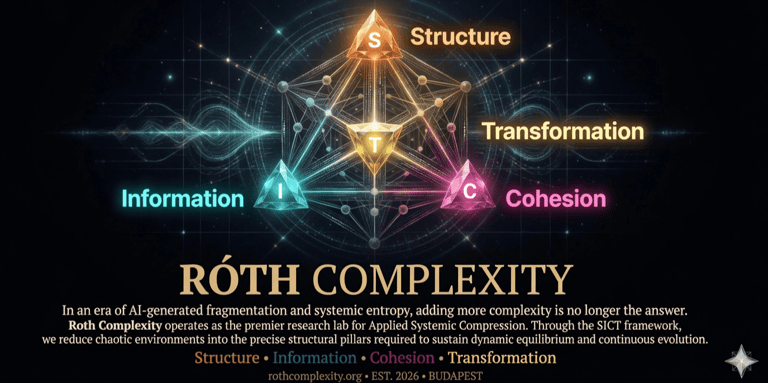
From Physical Earth-System Models, through AI Emulators, to Enterprise Decision Platforms — an S·I·C·T (Structure–Information–Cohesion–Transformation) Analysis
Róth Miklós Roth Complexity Lab
Working paper — conceptual / position paper with a falsifiability programme. Not peer-reviewed. Version 1.0 · 2026
Epistemic status. This paper proposes a diagnostic lens and an associated research programme; it does not report validated results, and it does not propose to replace the standard verification machinery of climate science (hindcasts, proper scoring rules, reliability diagrams, bias/RMSE analysis, energy- and mass-balance closure, ensemble calibration, physical sensitivity tests). Every substantive claim carries one of four calibration badges (legend at the end). The central honesty constraint, stated up front: the relation S + C ≥ I + T and the viability expressions built from it are definitional scaffolding presented for interpretation, not measured inequalities or derived laws. §6–§7 specify what would have to be measured to upgrade any of them.
Abstract
Public discussion of climate prediction routinely collapses a heterogeneous set of systems — global Earth-System Models, AI weather emulators, regional downscalers, data services, and enterprise climate-risk platforms — into a single category and asks which is "best." This is a category error: these systems solve different problems on different horizons. We analyse eleven representative systems through a four-coordinate systems-theoretic lens — Structure (S), Information load (I), Cohesion (C), Transformation pressure (T) — and argue that viability is horizon- and task-dependent rather than absolute. The paper's contributions are (i) a faithful comparative reading of the systems and their characteristic failure modes; (ii) five cross-cutting findings, of which the layer-boundary cohesion-loss chain, the false-cohesion correction for model interdependence, and the apparent-information-gain caution for generative downscaling are the most defensible; and (iii) an operationalisation (measurable indicators) plus six falsifiable hypotheses that convert the lens from interpretation into a testable programme. We are explicit throughout about which expressions are grounded, which are heuristic, and which remain speculative as written.
Keywords: climate modelling, Earth-System Model, CMIP6, NeuralGCM, GraphCast, ACE2, downscaling, climate risk, complex systems, systems theory.
1. Introduction: a category error
The claim that "the best climate-prediction systems combine physical Earth-System Models with fast AI models" is directionally reasonable but conceals a category error. Weather forecasting, seasonal forecasting, decadal prediction, multi-decadal scenario-dependent projection, regional downscaling, impact/risk analysis, and organisational decision support are distinct problems with distinct success criteria.
[GROUNDED] GraphCast targets ~10-day global weather; it was not designed to state Europe's climate in 2080. CMIP6 produces multi-decadal to centennial projections conditioned on socio-economic emission pathways; it does not predict the weather of a given day in 2080 but the change in the distribution of climate variables across assumed futures. The word "prediction" therefore must be used carefully: most multi-decadal output is conditional projection — if emissions, land-use, aerosols, and socio-economic trajectories follow a specified path, then the system responds within a stated range.
The operative questions are accordingly not just "is the model accurate?" but: on what horizon does it operate; what boundary conditions does it receive; which physical laws does it conserve; how does it represent uncertainty; can it extrapolate to novel climate regimes; and does its output actually reach the decision-maker. That last clause is why a systems lens, rather than a model-accuracy lens, is warranted.
2. The S·I·C·T lens for climate systems
[HEURISTIC] The lens decomposes any candidate system into four coordinates.
Structure (S) — the documented, reproducible constraints governing behaviour: physical equations; the computational grid or graph architecture; boundary and initial conditions; coupling of atmosphere, ocean, land, ice, and biosphere; parametrisations; experimental protocols; institutional version/data management. High S indicates strong, auditable constraint — not necessarily higher accuracy.
Information load (I) — not "useful data" but processing burden: input volume, variable count, uncertainty, inter-model spread, missing/noisy observations, scenario multiplicity, and the interpretive complexity passed to the decision-maker. A system can hold vast data yet fail to convert it into coherent knowledge; data quantity is not intelligence.
Cohesion (C) — quality of connection across parts: conservation of physical quantities; consistent sub-system coupling; agreement across spatial/temporal scales; ensemble calibration; model–observation linkage; data/metadata standardisation; and the link between a scientific result and an organisational decision. Crucially, agreement is not cohesion: several flawed models converging can manufacture false cohesion (§5.4).
Transformation pressure (T) — the change the system must absorb: greenhouse-gas forcing, accelerating warming, novel extremes, regime shifts, states outside the training distribution, infrastructure/supply-chain change, and the shrinking time available to decide. A data-driven model can excel inside its historical distribution and lose reliability quickly outside it.
[SPECULATIVE — as written] The framework advances an ordering slogan and a horizon/task-indexed viability scaffold:
Stability slogan: S + C ≥ I + T Viability scaffold: V(h, u) = S(h,u) + C(h,u) − I(h,u) − T(h,u)
where h is the forecast horizon and u the use-case. These are not evaluable inequalities as written, because S, I, C, T are not yet defined on a common, dimensioned scale. Their legitimate role is to make explicit a recurring intuition — that adding information load (I) or transformation pressure (T) without matching structure (S) and cohesion (C) is the shape of brittleness — and to insist that viability is relative to h and u. The remainder of the paper takes the discipline of saying exactly where this is grounded and where it is not.
3. Comparative system map
[GROUNDED] The table records role and qualitative S·I·C·T loading. It is not an accuracy ranking: high I and T denote burden; high S and C denote stabilising capacity.
System Actual function Typical horizon S I-load C T-exposure CMIP6 International model intercomparison & projection decade–century very high very high high, not complete very high Copernicus C3S Climate service: reanalysis, seasonal, projection delivery past–2100 high very high very high high NeuralGCM Hybrid physical–neural atmospheric model day–decade high high high in-distribution high in extrapolation GraphCast AI medium-range weather forecasting 1–10 days medium high high short-range low in its own range Ai2 ACE2 Fast AI climate emulator day–decade med-high high med-high high under novel forcing HiRO-ACE † High-resolution stochastic downscaling weather–decade med-high very high med-high high IBM Environmental Intelligence ‡ Enterprise climate/operational risk platform day–2100 medium very high organisation-dependent very high ClimateAI Agri/supply-chain climate risk day–decade medium high high in target sectors high World Bank CCKP Development-policy climate data portal historical–2100 high med-high high medium Climate Analytics tools Impact & warming-level visualisation decade–2100 medium medium high med-high Copernicus CDS ‡ Climate-data infrastructure & API past–2100 very high very high very high medium
† Product name unverified in this draft — confirm citation or correct. ‡ Product naming/ownership/infrastructure shifted in 2024–2025 — verify current status before citing.
4. System-by-system reading (condensed)
[GROUNDED] CMIP6. An ecosystem of protocols, experiments, SSP scenarios, runs, and data standards — not a model — and a foundational input to IPCC AR6 WGI. S is extremely strong (explicit physics, standardised protocols); I is extreme (many models, ensemble members, variables, scenarios → interpretive load); C is high but imperfect, because models share code lineage and parametrisations, so the multi-model mean is not a simple average of independent evidence; T is extreme by design. Key reading: CMIP's contribution is structured uncertainty — ensemble spread is a measurable footprint of residual cohesion deficit under shared constraints, not merely "error."
[GROUNDED] C3S / Climate Data Store. A service infrastructure (reanalysis, seasonal forecasts, CMIP/CORDEX projections, indicators), not a model. Key reading: its value is created by raising cohesion — standardised access, documentation, interoperability — which is itself part of the system's predictive capacity. Prediction quality is not set by base-model accuracy alone.
[GROUNDED] NeuralGCM. A differentiable physical solver coupled to neural networks, optimised end-to-end; usable for weather, ensemble, and multi-year runs at much lower cost. Key reading: the physical core constrains the neural model's freedom; hybridisation, however, creates a new cohesion interface. The hybrid is better only when cohesion across the two representations exceeds the new uncertainty introduced by their integration — C_interface > D_interface (a qualitative condition, not a measured one).
[GROUNDED] GraphCast. A graph-NN ~10-day global weather model trained on reanalysis that outperformed the operational deterministic forecast on many medium-range targets. Key reading: viability is horizon-dependent. V(10 days, weather) > 0 does not imply V(50 years, climate) > 0; extending the system beyond its validity range is the category error of §1.
[GROUNDED, with † flag] ACE2 / HiRO-ACE. ACE2 is a fast autoregressive atmospheric emulator with explicit conservation (dry-air mass, moisture); its independent CO₂/SST sensitivities are not yet fully realistic. The downscaling variant generates ~3 km regional precipitation fields from a ~100 km emulator. Key readings: (a) an emulator can inherit its reference model's errors — a faster copy is not necessarily a truer copy; (b) apparent information gain (§5.5) — fine structure that is statistically plausible is not thereby independently observed.
[GROUNDED, with ‡ flag] IBM Environmental Intelligence; ClimateAI. Both translate climate/weather signal into operational, financial, or supply-chain decisions. Key reading: their value lies mainly in model→decision cohesion, not in new climate theory. A superb hazard model reduces no loss without a responsible owner, pre-defined thresholds, an alert protocol, a budget, alternatives, and an executable adaptation plan. Domain specificity (ClimateAI) can raise cohesion to a concrete decision while narrowing generality; commercial architectures and independent benchmarks are typically less public than scientific models'.
[GROUNDED] World Bank CCKP; Climate Analytics; CORDEX. Portals compress information to decision-relevant indicators — selection here can be cohesion-raising compression, not information loss. CORDEX downscaling simultaneously raises S (finer regional structure), raises I (more local variables), can raise C (better orography/coastlines), yet inherits the driving global model's errors — a magnifier of the large-scale signal, not an independent source.
5. Five cross-cutting findings
[HEURISTIC] 5.1 — Information has a dual nature. In the base scaffold I sits purely on the load side. Climate practice shows information is both load and potential stabiliser. Let I_r be raw information and A ∈ [0,1] an assimilation capacity that depends on structure and cohesion, A = f(S, C). The unprocessed burden is I_b = (1−A)·I_r, giving a corrected scaffold:
V* = S + C − (1−A)·I_r − T
The same data volume is overload in a fragmented, standard-less organisation and decision advantage in an interoperable one. C3S does not necessarily reduce raw data; it raises A.
[HEURISTIC] 5.2 — Viability is a layered, weakest-link quantity. A full prediction system has at least four layers — observation, model, hazard/risk translation, decision/execution — each with its own V_k = S_k + C_k − I_k − T_k. The chain is governed by its weakest link, not its mean:
V_chain = min(V_1, V_2, V_3, V_4)
An accurate CMIP projection yields no adaptation if downscaling is wrong, hazard is not joined to exposure, the organisation lacks a decision protocol, or leadership does not execute. This is why "pick the most accurate model" is insufficient.
[GROUNDED] 5.3 — Cohesion loss compounds across layer boundaries. Let κⱼ ∈ [0,1] be the transmission fidelity between successive layers. Effective information reaching the decision is multiplicative:
I_eff = I₀ · ∏ⱼ κⱼ
With illustrative values κ = (0.95, 0.80, 0.60, 0.50), I_eff = 0.95·0.80·0.60·0.50·I₀ ≈ 0.228·I₀ — less than a quarter of the initial information becomes executed adaptation. This is ordinary serial-transmission arithmetic and is sound; the κ values are illustrative, not measured. It also locates where enterprise platforms (IBM, ClimateAI) add value: by raising the later κ, not by building a better global model.
[GROUNDED] 5.4 — False cohesion. High ensemble agreement is high confidence only if models are adequately independent, well-calibrated, and not repeating a shared structural error. Let observed agreement be C_o and shared-lineage dependence be D; corrected cohesion is:
C_corr = C_o − D
If many models share a cloud parametrisation, a historical data source, or an architectural assumption, their agreement over-states real confidence. Cohesion measurement must therefore include model independence, structural diversity, observational consistency, ensemble calibration, and out-of-sample tests. (This formalises the well-documented CMIP model-genealogy concern.)
[HEURISTIC] 5.5 — Apparent information gain in generative downscaling. Let I_r be raw, physically/observationally supported information and I_g generated detail. Displayed information is I_displayed = I_r + I_g, but epistemically independent information satisfies I_independent ≤ I_displayed. Statistically plausible fine structure is not independent observation; the larger I_g, the more essential it is to communicate uncertainty, ensemble spread, and reference-model dependence. Relatedly, transformation pressure is relative: with environmental change rate r_E, model-update rate r_M, and out-of-distribution distance D_ood,
T* = |r_E − r_M| + D_ood
When climate shifts faster than a model ingests new observations, processes, and regimes, transformation burden grows — most acutely for purely data-driven models, since excellent fitting of the past does not guarantee modelling of previously non-existent states.
6. Operationalisation: measurable indicators
[HEURISTIC → testable] To move beyond interpretation, each coordinate is bound to candidate measurables (illustrative; each requires validation as a proxy).
Structure: conservation errors; energy/water-budget closure; number of explicitly coupled sub-systems; documented boundary conditions; reproducibility; code/version accessibility; number and strength of physical constraints.
Information: input variable count; effective dimension; missing-data fraction; observational uncertainty; ensemble entropy; inter-scenario spread; data-refresh latency.
Cohesion: coupling errors; multivariate physical consistency; ensemble calibration; cross-scale consistency; metadata compatibility; observation agreement; model→decision hand-off success.
Transformation: distribution shift; distance of forcing from the training range; change in extreme-event frequency; model-update latency; forecast horizon; decision reaction time; rate of structural change.
7. Falsifiable hypotheses
[HEURISTIC → testable] The lens earns scientific standing only via claims that can lose. Each is testable with controlled hindcasts, ablations, ensemble comparisons, or organisational case studies.
H1. Hybrid AI models with physical constraints lose calibration more slowly with increasing horizon than comparably sized purely data-driven models.
H2. Growth in conservation error precedes long-run climate drift.
H3. Apparent ensemble cohesion falls once model dependence is accounted for, and the corrected cohesion (C_corr) predicts out-of-sample error better than raw agreement.
H4. Enterprise adaptation effectiveness is explained more strongly by risk-translation and organisational cohesion than by raw model spatial resolution.
H5. High-resolution generative downscaling raises users' subjective confidence even when ensemble uncertainty does not objectively decrease.
H6. When transformation pressure exceeds structural+cohesive capacity, model error variance, autocorrelation, or calibration drift begins to rise before performance collapse — a critical-slowing-down precursor analogous to early-warning signals in complex systems.
H3, H5, and H6 are the most discriminating: each predicts a specific, pre-registerable failure of the naive intuition (agreement = confidence; resolution = knowledge; smooth degradation), and each can be falsified by "no association."
8. A proposed layered hybrid architecture
[HEURISTIC — design proposal, not a validated system] The strongest properties of existing systems compose into a layered ecosystem rather than a monolith:
Physical base — CMIP-class ESMs for long-run physical consistency and forced response.
AI emulation — NeuralGCM/ACE-class systems for fast ensembles, sensitivity studies, learned parametrisation, cost reduction.
Regional / extremes — CORDEX/HiRO-ACE-class downscaling for orographic, coastal, and local extreme representation (with explicit I_g flagging per §5.5).
Observation / reanalysis — ERA5, satellite, radar, ocean buoys, surface networks for initialisation, validation, bias correction, updating.
Risk translation — joining hazard to exposure, vulnerability, asset value, supply chain, and adaptation options.
Decision — explicit intervention thresholds, ownership, budget, alternatives, and measurable adaptation outcomes.
The claim is not that this is more accurate, but that it raises V_chain by attacking the weakest link (§5.2) and the later κ (§5.3).
9. Limitations
In its present form S·I·C·T is a diagnostic and hypothesis-generating framework, not a validated alternative to standard verification. It does not replace hindcast evaluation, proper scoring rules, reliability diagrams, bias/RMSE analysis, energy/mass-balance checks, ensemble calibration, or physical sensitivity tests. Its added value is a shared systems-theoretic language linking model architecture, data load, physical and institutional coherence, a changing environment, and decision execution. Its scientific status depends on operationalising the §6 indicators, pre-registering thresholds, and running the §7 tests independently. The analysis also rests on a single proprietary lens applied to a curated system set; both choices import selection effects, and the commercial systems' internals are only partially public.
10. Conclusions
The modern climate-prediction landscape is not built around one model. It is an ensemble of physical ESMs, AI emulators, reanalyses, regional downscalers, data portals, risk platforms, and organisational decision systems. Under the S·I·C·T reading: CMIP supplies structural pluralism and long-run physical projection; C3S/CDS supply information interoperability and institutional cohesion; NeuralGCM integrates physical structure with learned representation; GraphCast is an outstanding short-horizon information processor but not a standalone multi-decadal climate model; ACE2/HiRO-ACE provide fast emulation and high-resolution probabilistic detail while remaining dependent on training and reference models; IBM EIS and ClimateAI raise the climate-signal-to-intervention cohesion; World Bank and Climate Analytics compress information into decision-usable form.
The central finding is that prediction effectiveness does not rest on model accuracy alone: the viability of the whole observation→model→risk→decision→execution chain must be assessed. The strongest future system is therefore unlikely to be one monolithic super-model, but a layered, open, continuously validated ecosystem in which S + C ≥ I + T holds not only for the computational model but for the entire scientific-and-decision system.
Calibration badge legend
[ESTABLISHED] — Settled, consensus knowledge. (Not used in this paper.)
[GROUNDED] — Well-supported by a specific, checkable source or directly verifiable reasoning.
[HEURISTIC] — A useful, defensible device or interpretation; not predictive or proven.
[SPECULATIVE] — A conjecture or scaffold presented for interpretation; not currently testable as written.
References
(Scientific systems — peer-reviewed / institutional.)
Eyring, V., et al. (2016). Overview of the Coupled Model Intercomparison Project Phase 6 (CMIP6). Geoscientific Model Development, 9.
IPCC (2021). Climate Change 2021: The Physical Science Basis (AR6 WGI), Ch. 4 (Future Global Climate).
Hersbach, H., et al. (2020). The ERA5 global reanalysis. Quarterly Journal of the Royal Meteorological Society, 146.
Lam, R., et al. (2023). Learning skillful medium-range global weather forecasting (GraphCast). Science, 382.
Kochkov, D., et al. (2024). Neural general circulation models for weather and climate (NeuralGCM). Nature, 632.
Watt-Meyer, O., et al. (2023/2024). ACE / ACE2: a fast, skillful learned global atmospheric model for climate prediction. Allen Institute for AI (Ai2). [ACE2 and the high-resolution "HiRO-ACE" variant: confirm exact titles/identifiers before submission.]
Knutti, R., et al. (2013). Climate model genealogy: Generation CMIP5 and how we got there. Geophysical Research Letters, 40. (Supports §5.4 false cohesion.)
Scheffer, M., et al. (2009). Early-warning signals for critical transitions. Nature, 461. (Supports H6 critical slowing down.)
Gutowski, W. J., et al. (2016). WCRP CORDEX: a diagnostic MIP for CMIP6. Geoscientific Model Development, 9.
(Services / platforms / portals — product or institutional documentation, not peer-reviewed; verify current status.)
Copernicus Climate Change Service (C3S): Climate Data Store, ERA5, seasonal forecasts, CMIP/CORDEX catalogues.
IBM Environmental Intelligence (Suite): product and climate-risk documentation.
ClimateAI: ClimateLens / enterprise climate-resilience documentation.
World Bank Climate Change Knowledge Portal and methodology guidance.
Climate Analytics: Climate Impact Explorer and PROVIDE Climate Risk Dashboard.
Roth Complexity Lab: S·I·C·T Framework (proprietary; presented here as a heuristic lens with no peer-reviewed standing).
S·I·C·T is a proprietary conceptual framework of the Roth Complexity Lab. The bracketed source groups [1]–[12] of the source draft should be expanded to specific references before any submission.


Introduction to Climate-Prediction Infrastructures
The assessment and prediction of climate variability and change have become crucial due to the increasing impacts on ecosystems and human societies. This blog post provides a systems-theoretic comparison of different climate-prediction infrastructures, delving into physical earth-system models, AI emulators, and enterprise decision platforms. Using an S·I·C·T (structure–information–cohesion–transformation) analysis framework, this discussion aims to highlight the strengths and limitations of these methodologies.
Physical Earth-System Models
Physical earth-system models play an essential role in offering a comprehensive approach to climate prediction. These models incorporate detailed representations of the earth's physical processes, encompassing atmospheric, oceanic, and terrestrial systems. The strength of these models lies in their ability to simulate real-world climatic phenomena, providing unprecedented insights into long-term climate patterns. However, their complexity and high computational demands can pose significant challenges, particularly in terms of scalability and timely data generation.
AI Emulators in Climate Prediction
Artificial Intelligence (AI) emulators have emerged as an innovative alternative to traditional climate-prediction models. Utilizing machine learning techniques, these emulators can analyze vast datasets, making it possible to achieve quicker and more efficient predictions. The adaptability and resilience of AI algorithms allow them to continually improve their forecasts as new data becomes available. Despite these advantages, concerns regarding the opacity of AI decision-making and potential biases in training data remain key hurdles that must be addressed to enhance their reliability.
Enterprise Decision Platforms
Enterprise decision platforms offer a holistic approach to climate predictions by integrating various data sources and models, creating a comprehensive decision-making environment. By leveraging advanced analytics, these platforms facilitate strategic planning and resource allocation based on climate forecasts. They are particularly beneficial for businesses and government entities that need to make informed decisions regarding climate change adaptability. Nevertheless, the effectiveness of these platforms often hinges on the availability of high-quality data and the ability of users to interpret complex predictions.
Conclusion: The Need for Integration
Each climate-prediction infrastructure presents unique advantages and limitations, emphasizing the necessity of a structured comparison. By employing the S·I·C·T framework, stakeholders can better understand how various models operate and influence decision-making. A critical avenue for future research involves bridging the gaps between these infrastructures, thus fostering collaboration that enhances predictive capacity and increases climate resilience. As the implications of climate change continue to escalate, it becomes paramount for researchers and practitioners to work together and adopt a systems-theoretic approach in developing robust climate prediction infrastructures.
Contact
Reach out for insights or collaboration.
© 2025. All rights reserved.
Phone