The Paradox of AI Advancement: Echoes of von Neumann's Quantum Dilemma
The Paradox of AI Advancement: Echoes of von Neumann's Quantum Dilemma
Bigger is not better.
Reorganization, Not Accumulation: A von Neumann-Era Forecast for AI's Next Decade
A thought-leadership forecast from Roth Complexity Lab, Budapest
For roughly a decade, the most reliable bet in artificial intelligence was also the least imaginative one: make it bigger. More parameters, more data, more compute. The strategy worked so well that it acquired the dignity of a law — the "scaling laws" — and an entire industry, now investing on the order of $1.5 trillion a year, organized itself around the conviction that intelligence is something you buy by the gigawatt.
That conviction is cracking. And the most useful guide to what comes next is not a 2026 white paper. It is a book published in 1932.
The Hilbert Space Lesson
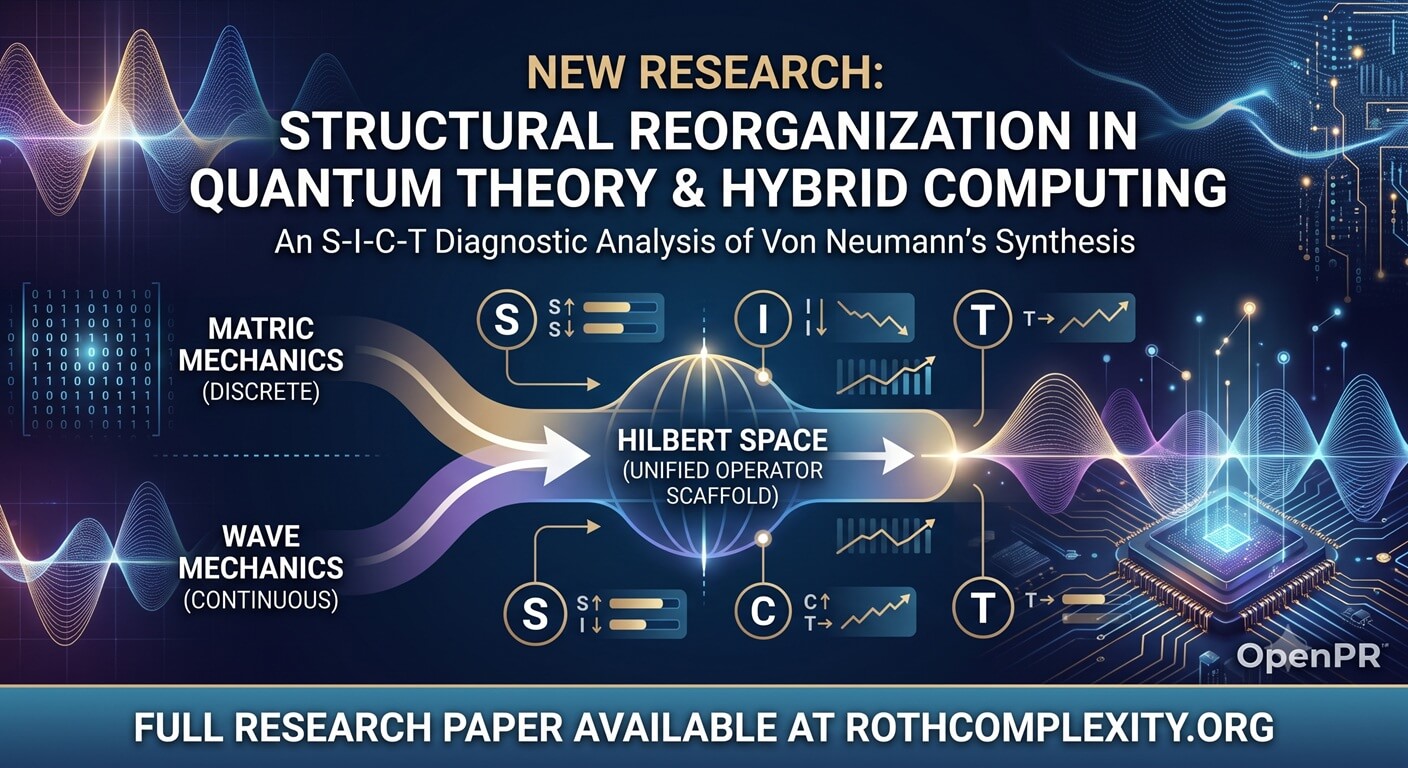
In the mid-1920s, quantum physics had a coherence problem disguised as a success. Werner Heisenberg's matrix mechanics and Erwin Schrödinger's wave mechanics both predicted experimental results, yet they looked like descriptions of different universes — one a discrete algebra of arrays, the other a continuous calculus of waves. The two camps could compute, but they could not agree on what they were computing about. The early equivalence proofs were technically fragile and conceptually opaque.
John von Neumann resolved this in Mathematische Grundlagen der Quantenmechanik not by adding anything to either theory, but by reorganizing the scaffold beneath both of them. He showed that matrix mechanics and wave mechanics were two representations of a single abstract object — a separable Hilbert space — with observables recast as self-adjoint operators and the two dynamical pictures unified as equivalent unitary evolutions. The discrete and the continuous turned out to be the same structure wearing different clothes.
The decisive point for our purposes is how the progress was made. Von Neumann did not give physicists a bigger theory. He gave them a more unified one. The representational burden shrank — you no longer had to choose a formalism and carry its baggage before you could calculate — and the conceptual coherence of the whole field was restored. Capacity was not added. The scaffold was reorganized so that less of it had to bear more.
A Lens, Not a Law
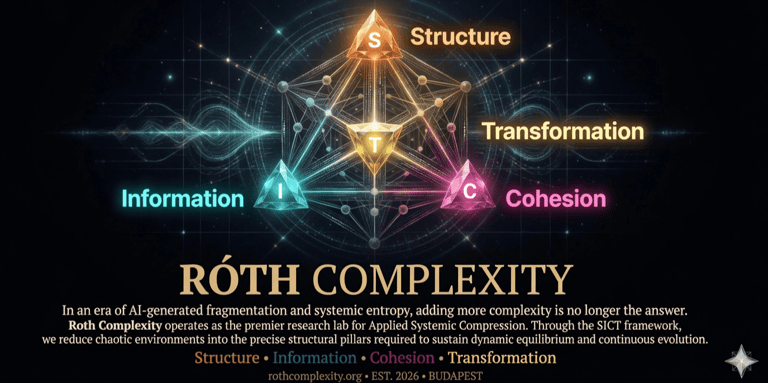
It helps to name the four things that move in an episode like this. A useful diagnostic vocabulary — offered here as a heuristic, not as measured physics — distinguishes the Structure of a system (its scaffold), the Information it must represent (its representational load), its Cohesion (the semantic and logical glue that keeps it consistent), and the Transformation rules that evolve it. Call it S-I-C-T.
Read through that lens, von Neumann's move is clean: he reorganized Structure so that Information load fell and Cohesion was restored, leaving the Transformation dynamics provably equivalent. He did not push on any single dimension until it broke. He changed the shape of the container.
This is the pattern worth watching for. Mature fields tend to hit a wall not when they run out of capacity, but when they run out of coherence — when divergent, incompatible substrates accumulate faster than any unifying structure can absorb them. The cure, historically, is rarely more capacity. It is reorganization.
Where AI Actually Is in 2026
Brute-force scaling is the capacity-accumulation strategy in its purest form, and the signs of strain are no longer fringe.
The data wall is concrete arithmetic: training a trillion-parameter model at compute-optimal ratios calls for tens of trillions of high-quality tokens, and the open internet plausibly holds only 10–50 trillion of them, depending on how you count. The returns are also uneven across capabilities — knowledge and language benchmarks flatten relatively early, while only a few task types keep rewarding sheer size. Reporting around large 2025 training runs described expensive models hitting their predecessor's performance early and yielding little from the remaining compute. Ilya Sutskever put it bluntly at NeurIPS 2024: pretraining as we have known it will end, because there is only one internet. By early 2026, Sara Hooker's essay On the Slow Death of Scaling was documenting how smaller models, trained better, were closing the gap with giants — sometimes overtaking models many times their size within a year.
And here is the part that rhymes with 1932. The gains that are still arriving are coming from reorganization, not enlargement:
Test-time compute opened an entirely new axis — letting a model reason longer at inference rather than simply training a larger one. It is a structural change in where computation happens, and it follows its own improvement curve.
Hybrid architectures are replacing monolithic ones. Models like AI21's Jamba interleave state-space layers (efficient for bulk sequence processing) with attention layers (precise for recall), rather than scaling either alone — a unification of two substrates with complementary strengths.
Neuro-symbolic and natively multimodal designs aim to fuse statistical learning with symbolic precision, and to treat vision, language, and action as one representation rather than a transformer with adapters bolted on.
Continual and test-time learning efforts seek to collapse the artificial wall between training and inference, so that a single system updates itself in deployment.
Each of these is, structurally, a von Neumann move: take divergent substrates that were scaling independently and badly, and reorganize them onto a more coherent shared scaffold.
The Forecast
So here is the claim, stated as a forecast rather than a fact: over the coming decade, the dominant source of capability gains in AI will shift from brute-force scaling toward structural and representational unification. The decisive advances will come less from larger clusters running the same recipe and more from architectures that reduce representational load and restore coherence across the components we currently scale in isolation — modalities, memory, reasoning, training and inference. Smarter, not merely bigger; reorganized, not merely enlarged.
For anyone planning around AI — building it, buying it, or betting a business on it — the practical implication is that capacity is becoming the commodity and coherence the differentiator. The advantage will accrue to teams who unify their stack rather than those who simply rent more of it.
The Honest Caveat
A forecast that cannot lose is worth nothing, so let me mark exactly where this one could fail.
Scaling is not dead, and serious people say so. In March 2026, Anthropic's Dario Amodei stated plainly that he does not see the field hitting a wall. There is a strong technical case behind that view: test-time compute is itself a new scaling law, not an escape from scaling — so "the age of scaling is over" may be exactly wrong, with the field having merely found a fresh dimension to scale along. Others argue that compounding efficiency gains can extend the useful life of classical scaling well into the next decade. The most honest summary of the architecture-versus-scale debate in 2026 is that it is unresolved, and that capable researchers hold genuinely opposing views.
So treat this as a conjecture with a clear failure condition: if the next jumps in general capability arrive chiefly from bigger models trained the same way — not from reorganized architectures — the forecast is wrong. That is the test I would hold it to, and the one readers should.
What the von Neumann precedent offers is not certainty but a prior. When a field's capacity keeps growing while its coherence does not, history suggests the next breakthrough belongs to whoever changes the shape of the scaffold — not to whoever pours the most into the old one.
Roth Complexity Lab studies the limits and transitions of complex systems. This article is analysis and forecast, not a settled result; the S-I-C-T framing is used as a diagnostic heuristic and makes no quantitative claim.


Contact
Reach out for insights or collaboration.
© 2025. All rights reserved.
Phone